
Recently, I saw an online course advertising that someone could become a psychedelic integration specialist in seven days. That caught my attention, and honestly, it worried me a little. It made me think about a question that seems to come up more and more these days: do people really need psychedelic integration, or do they actually need therapy?
Over the years, I’ve noticed something very consistent. When someone comes to drink ayahuasca, and they have already done therapy regularly, they usually process the experience much better and can give meaning to it more easily. They seem more connected to what is happening during the ceremony. Certain parts of the experience are easier for them to understand because they have already spent time navigating their inner world. They have practiced looking inward, recognizing emotions, and making sense of what comes up.
Something similar can happen with people who meditate regularly or have a strong yoga practice.
Someone who hasn’t been in therapy can still have a powerful and beautiful experience, of course. Ayahuasca can open many doors for anyone. But the results can look different. When a person has done therapy, they tend to have tools they can use afterward. They know how to sit with emotions, reflect on what they saw or felt, and translate those experiences into changes in their daily life.
Many people also process their experiences through creative paths like art, music, writing, or movement. These can be very meaningful ways of expressing what the medicine brings up. At the same time, the deeper inner work, learning to name emotions, feeling what needs to be felt, and working through difficult memories or patterns, often requires a space specifically designed for that process. That’s where therapy becomes important.
Stoos, Switzerland. 2025
The Problem With Extremely Short Trainings
One of my concerns arises when I hear about very short trainings for integration specialists, or even brief trainings for facilitators. Nowadays, some people spend only a few weeks in the jungle and then begin leading ceremonies on their own. This happens in Costa Rica with foreigners as well as locals.
Imagine someone comes out of a ceremony and something very deep surfaces. Perhaps a trauma appears that had been hidden for years, or strong emotions arise that the person has never faced before. If the person they turn to for integration is not trained to work with trauma, they may not know how to guide that process safely.
Instead of helping the participant move through the experience, they might unintentionally create more confusion or even more distress.
Being trauma-informed is the least a facilitator should have, which means that they can recognize the trauma, but do not interfere or ask direct questions about it. They only listen.
Ayahuasca can open powerful psychological and emotional material. That is why the role of integration requires maturity, humility, and often a solid understanding of mental health dynamics. Without this foundation, a well-intentioned guide may offer interpretations or advice that complicate the process rather than supporting it.
The Importance of Boundaries With Facilitators
There should also be healthy boundaries in what participants expect from their facilitator.
In most cases, the facilitator is not a therapist. Their role is often closer to that of a supportive presence or witness rather than someone who analyzes or interprets every aspect of your experience. Ayahuasca itself already works very deeply with the individual, and sometimes adding too much interpretation can create unnecessary complexity.
Another dynamic that occasionally appears after ceremonies is the impulse to share everything immediately. People may feel an urge to unload their entire personal history, their trauma, or all their worries in the moment.
While the intention may be sincere, dropping all of one’s emotional material onto someone who is not trained to receive it can create unnecessary vulnerability. It can also place the facilitator in a role they are not prepared to hold.
Even trained psychotherapists understand that deep psychological material cannot simply be processed all at once. Therapy unfolds gradually, session by session, with careful pacing and containment, and there is a reason for that; it’s important to acknowledge this here.
Many facilitators, however, are not trained to hold intense trauma disclosures, and the ceremonial setting is not designed to process every layer of someone’s psychological history.
When people disclose too much, too quickly, especially to someone who is not a trained clinician, they may later feel emotionally exposed or destabilized. What initially felt like relief can sometimes turn into regret, shame, or confusion about what was shared. This doesn’t just apply to facilitators, but in real life, you should also not do this with your friends or family.
For this reason, it can be helpful to see the facilitator as a companion in the process rather than someone who will receive everything that lives in your mind and heart. A certain capacity to hold yourself emotionally is important. Being able to remain grounded within your own experience often allows the medicine to work more clearly and constructively.
Of course, every participant relates to the process differently. Some people share very little and prefer to focus inwardly. Others feel a strong need to speak about everything that arises. At times, this can shift into a dynamic where the person seeks validation, attention, or emotional witnessing to an excessive degree.
In those moments, what appears as openness may actually become emotional overexposure or dependency.
Healthy ceremonial spaces benefit from balance: the freedom to share what truly matters, while also maintaining personal responsibility and respecting the limits of the facilitator’s role.
Sacramento, Heredia, Costa Rica.
When “Integration” Becomes a Substitute for Therapy
Because of this, I sometimes feel that people believe they need psychedelic integration when what they may really need is therapy.
Integration can even become a way of avoiding therapy without realizing it.
Therapy is not always easy. When someone truly commits to it, it usually means going regularly for a period of time and slowly unpacking things that may have been carried for years. It takes patience, honesty, and finding a therapist you connect with. If you don’t feel that connection, it’s completely reasonable to look for someone else.
Therapy is a structured space created specifically for this kind of work. Without that structure and training, conversations about psychedelic experiences can sometimes leave people with more doubts than clarity.
Responsibility and Experience Among Facilitators
This also raises an important point about facilitators themselves.
In traditional contexts, people who serve ayahuasca usually spend years learning the practice. They diet with the plants, study with a teacher, and develop a relationship with the medicine over time. It is not something that traditionally happens quickly. The process involves discipline, patience, and guidance from someone who has already walked that path. Understanding the bodies.
These days it’s becoming more common to see people do a short dieta somewhere and then return saying they are ready to facilitate ceremonies. Personally, I think this is something that deserves reflection. Working with this medicine carries a lot of responsibility, both toward the medicine itself and toward the people who come seeking help or insight.
Another aspect I think about is the inner work of facilitators themselves. Not because they need to act as psychologists, but because they should know themselves well. They should have explored their own patterns, their own wounds, and their own emotional landscape.
Therapy can be a very valuable part of that process.
When people consider working with a facilitator, it’s reasonable to ask questions:
How long have they been working with the medicine?
Who did they learn from?
What kind of personal work have they done themselves?
These questions are not about judging someone. They are about understanding who is holding the space you are stepping into.
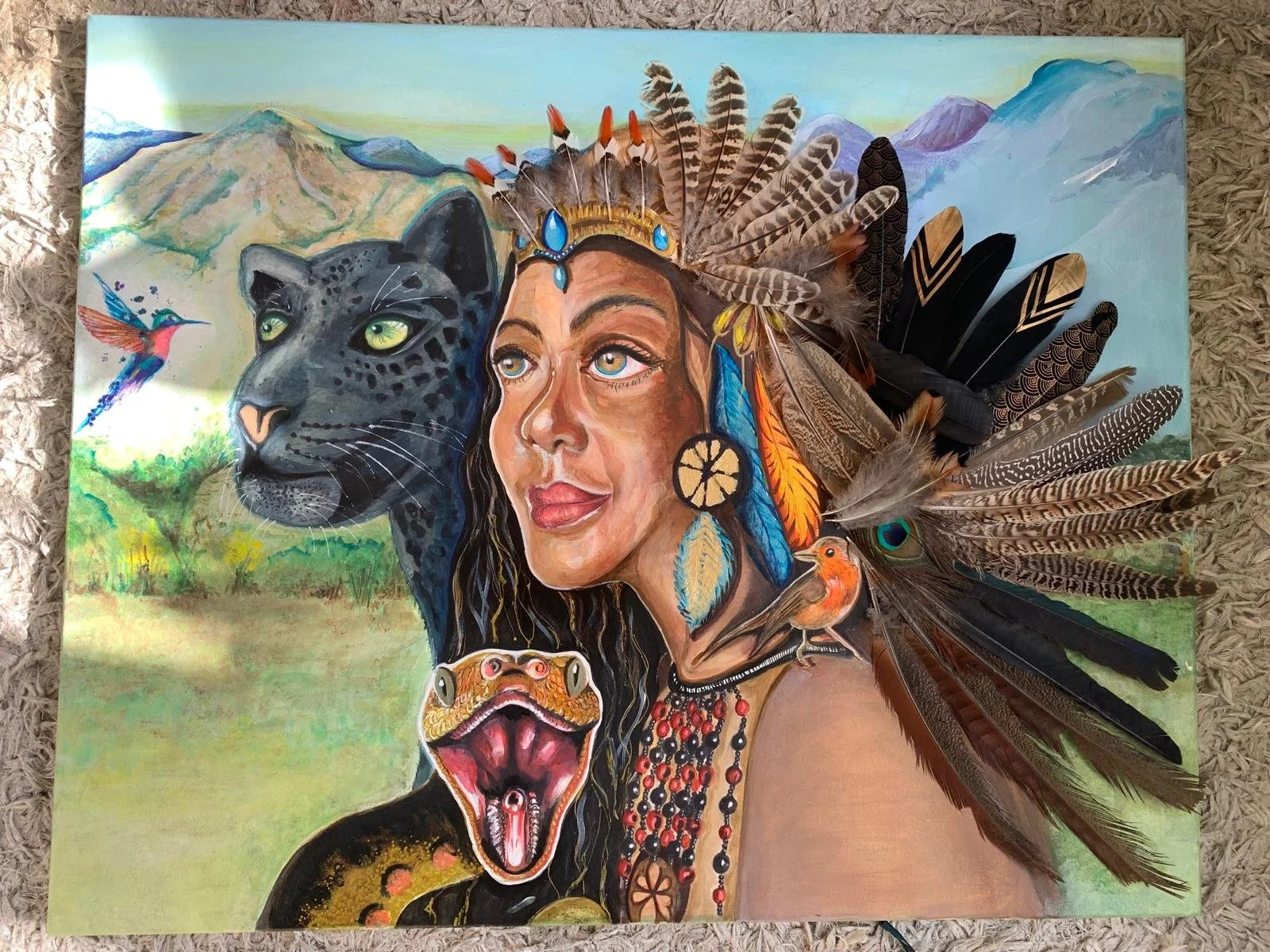
Art from Ann-Marie - United Kingdom
Personal Reflections
Speaking personally, I have not followed the traditional path of doing many formal dietas with a shaman. I have done my own work with the medicine, but I understand that in the eyes of traditional practitioners, this is not the same.
Even so, this did not prevent me from facilitating ayahuasca ceremonies for the past nine years. From the beginning, I understood that the way I work with ayahuasca is an adapted form, and that certain elements would naturally be different from traditional shamanic frameworks; we don’t have the dieta plants in Costa Rica.
For example, I do not interpret the experience through ideas about external entities, demons, or evil spirits attaching themselves to people during ceremonies as my shaman taught me. I consider myself a very grounded person. I have explored those concepts and even considered them intellectually at times, but they never led me to a coherent understanding of the world around me.
Shamanic interpretations may have served an important role in the past, or as guiding symbols, but today we also have access to psychology, neuroscience, and other ways of understanding human experience. In my view, it makes sense that the practice evolves.
I have heard of people going to ayahuasca shamans to “remove dark spirits,” which to me can sound more like exploitation than healing. One of my own teachers used to say something much simpler: eat healthy, stay strong, and nothing will come through or after you.
The Role of Psychotherapy in Preparing for Ayahuasca
So how can psychotherapy actually support an ayahuasca experience and help create more lasting results?
The first step is preparation.
Going to therapy for some time before participating in a ceremony can help you understand yourself better. You do not even have to talk about ayahuasca during those sessions. You can simply attend therapy for the reasons you would normally go.
You might be dealing with depression, anxiety, ADHD, grief, or a difficult life transition. Perhaps someone close to you is very sick, and you are facing the possibility of losing them. Experiences like these can occupy the mind and affect the emotional landscape deeply.
Working through the thoughts and feelings that keep returning in your mind and heart is already valuable preparation. Even without mentioning ayahuasca, this kind of work can make a significant difference. These two things don’t have to necessarily be combined.
Another part of preparation is exploring fears and unresolved experiences from the past. Sometimes, events we believe are no longer affecting us still shape our reactions more than we realize. When these areas are addressed beforehand, the ayahuasca experience can be gentler and easier to understand.
Without preparation, some people simply react to the experience instead of integrating it.
Neckar River, Nürtingen, Stuttgart. Germany 2025.
Therapeutic Approaches That Can Help
Personally, I am not very supportive of some older therapeutic frameworks when combined with ayahuasca work. Psychedelic experiences often require something grounded and practical, let’s say nothing too complex.
Therapies that can be particularly supportive include:
• Person-Centered Therapy (Carl Rogers)
• Dialectical Behavior Therapy (DBT)
• Cognitive Behavioral Therapy (CBT)
These approaches often provide practical tools for emotional awareness, language, and behavioral change.
Integration After the Ceremony
After the ceremony, therapy can also help people process what happened.
When speaking with a therapist, it is often more helpful to focus on how the experience made you feel rather than trying to interpret every symbolic image or vision.
Many therapists may not be familiar with psychedelic imagery, but they can still help you explore important questions:
How did the experience affect you emotionally?
How are the aftereffects influencing your life weeks later?
Were there difficult or chaotic moments during or after the ceremony?
Did something inside you shift or awaken?
In this sense, the ayahuasca experience can provide meaningful material for therapy, as it often brings unconscious material to the surface.
Some people also find that after such an experience, they feel motivated to continue therapy for other aspects of their life. Continuing therapy can be very beneficial and help the effects of the medicine last longer.
However, therapies that extend for ten years are not something I personally recommend today. The time, cost, and weekly commitment can become excessive for many people, and then we have another dependency situation.
A reasonable starting point might be 6 to 12 weeks of therapy. After that, you can decide whether to continue for another period, depending on your needs and the therapist’s guidance. I am saying this based on my own experience.
It is also important not to become overly dependent on therapy.
The goal is not to rely excessively on a therapist or facilitator. One of the challenges facilitators sometimes encounter is when participants become too dependent on them. Not because it is inconvenient, but because it can mean the person is losing confidence in their own ability to process their experiences.
Ideally, you should be able to hold and reflect on much of your experience yourself, while receiving guidance and support when needed.
All of this comes from a place of care, both for the people who come to this work and for the medicine itself.
Ayahuasca experiences can be very powerful, and they deserve to be approached with honesty, patience, and responsibility.
When people prepare themselves, understand the role of therapy, and approach medicine with maturity, the experience can become not only profound but also deeply meaningful in the long term.
Thank you for reading.