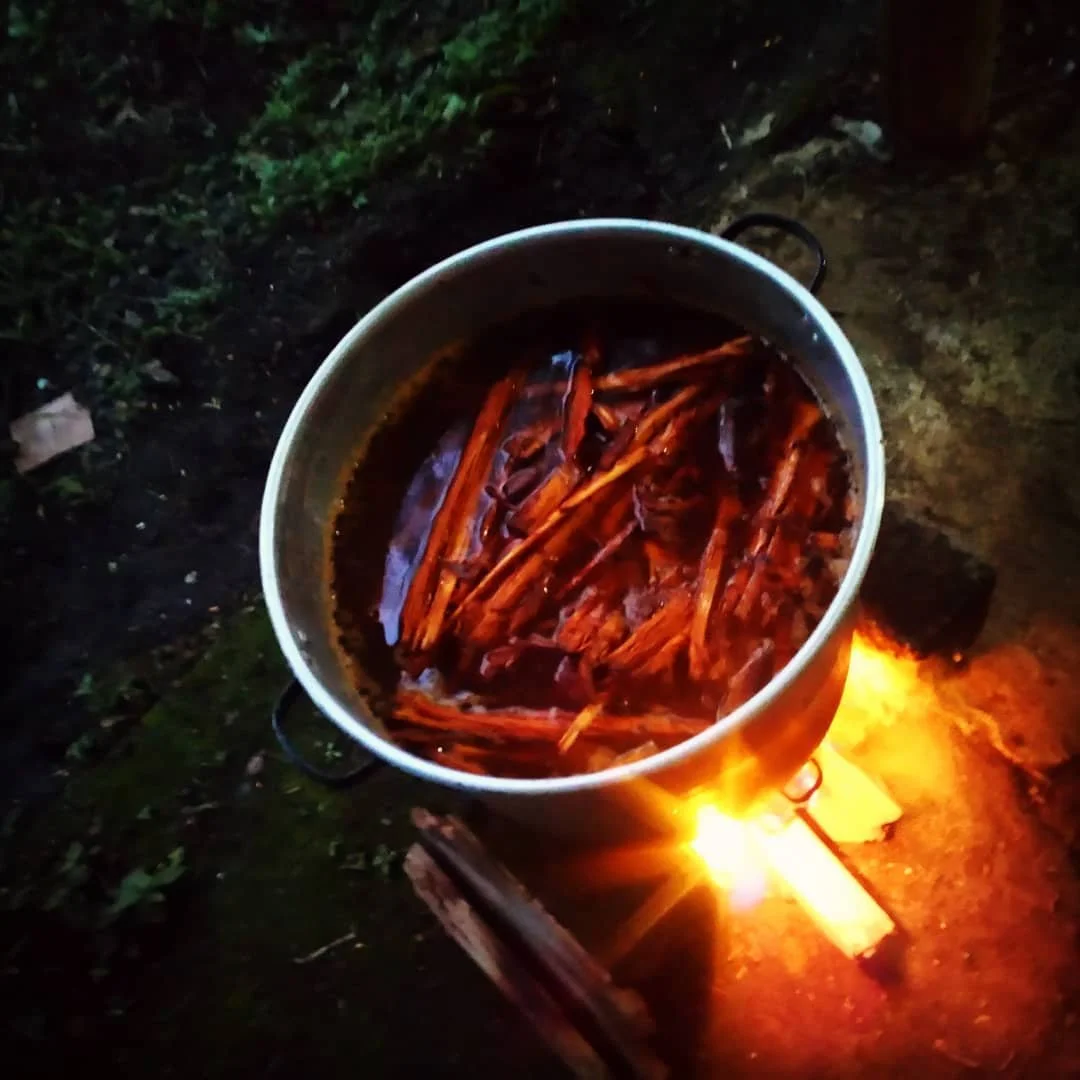
What Happens When Someone With Schizophrenia Drinks Ayahuasca
Today I want to talk about something I've never written about publicly before: what happens when someone who has schizophrenia drinks Ayahuasca.
I want to be clear from the start that I'm not writing this from a medical or clinical perspective, but from an experiential one. Over the years I've worked with people showing all kinds of symptoms and behaviors that I didn't always know how to understand or approach. I think most of us are in that position, we're not inherently knowledgeable about psychotic conditions.
We tend to assume that someone with schizophrenia or psychosis is dangerous, that they're "out of this world," that they're going to do something crazy. What people don't realize is that these individuals live among us. Depending on where they fall on the spectrum, and depending on their specific symptoms, some hide it very well. Some don't even know they have it. So, the first thing to understand is that you can't diagnose someone just from symptoms you observe. That has to be done by a professional, someone who knows what they're doing and who can run the physical and medical tests needed to reach an accurate diagnosis, whether it's schizophrenia flavor, a delusional disorder, or something schizoid.
What I can offer is a way to help you recognize signs that might mean something is going on, enough to know when to encourage someone toward medical attention, and enough to protect yourself if you ever encounter someone disruptive or hostile who may be dealing with this.
My first real experience with someone I suspect was schizophrenic — based on what he told me and what I saw myself — falls under a category that requires symptoms lasting more than six months: delirium, hallucinations, a lack of insight that can look like lying but is actually someone's reality playing tricks on them, deep distrust of others, beliefs that the government is watching or spying on them, or that they can communicate with trees, animals, nature, or the dead. It depends on the specific delusion or hallucination. A belief in synchronicities, that things happen for a magical reason, or because of a past-life connection, can be part of it too, though plenty of people hold beliefs like that and are completely fine. You know what I mean. And sometimes psychotic symptoms don't come from schizophrenia at all, they can show up after heavy hallucinogen or drug use, after a major trauma, or from an unrelated medical condition.
This first man came to us as a volunteer, and he's actually someone who has written a lot about us online over the years, alongside his "therapist." I want to be clear that I'm sharing this as an educational story, not a resentful one. This experience taught me a great deal. Real retreats get comments like this, the ones doing real work, working with people across the full spectrum of mental health, are going to run into this. People who understand Ayahuasca deeply understand this. Never having a single bad review usually means someone is paying to remove them, or the reviews are ghostwritten.
This experience was deeply traumatizing for me, and part of why I want to share it now is so others can understand this a little better, so that if they encounter something similar, they won't be as frightened or shaken as I was back then.
He arrived to vlunteers, as a nice, gentle guy with an overly kind tone from the United States. He didn't seem to know much about what he was getting into and was being pushed along by someone else who didn't know much about his condition. The guy looked tense the entire time, very tense. Something in me was determined to look into things further before giving him Ayahuasca, which is part of our process anyway: a more adapted, careful approach. He was going to stay 30 days. In the days before, he'd worked hard, but besides this, he spent most of his time on the phone, and rarely went outside to walk or look at the trees. He stayed in his room. Looking back, his behavior was clearly off, though I didn't register it fully in the moment. My intuition told me he wasn't ready, and I trusted it.
We were talking on the hill one day, about four or five days after he'd arrived. He asked if I had any weed. I said yes — I smoke cannabis occasionally, and it's one of maybe fifteen other plants and extracts I keep at home. It's not unfamiliar to me. He wasn't going to drink Ayahuasca for another two or three weeks, so there was no diet to worry about yet, and other volunteers had asked for weed before without any issue. We smoked, had a laugh, nothing unusual.
Except nothing happened to him. He took two or three puffs and stayed exactly the same — tense, inward, not laughing at all, just clouded. I thought the cannabis might help him relax but still after this I felt something still weird in him impossible to describe. Psychosis has that quality; it expresses itself directly from the unconscious, the strange and abstract part of the mind that — as Lacan put it — is structured like a language. It's worth saying here, since so much online content focuses on "narcissists" without ever mentioning this: someone with schizophrenia can look exactly like a narcissist, minus any awareness of what they're doing. That's not something to shame a person for. If a mental illness makes someone act strangely, they can't be blamed for it any more than they could be convicted for an act they had no control over.
A couple of hours later, as night fell, he started having intense hallucinations in the deck outside, and he was terrified. So was I. We were both petrified. I tried to stay calm and just follow along with what he was experiencing. He told me everything felt chaotic, that he saw me as a devil and didn't want to be near me. I never pushed back against what he believed, instinct told me that was the right call. I just kept agreeing, kept telling him everything was okay.
Then he said he only wanted to be near my mother. He saw her as an angel. She was a few meters away, thinking we were having a normal conversation. I switched to Spanish and told her something was wrong and that we needed to take care of him. I slipped into a kind of ceremony mode, putting everything I had into containing the situation, which, as I'll explain, wasn't the right call.
He walked over to my mother, led her into the living room inside, and locked the door. I couldn't get in. In that state, I had no idea what he might do, and I panicked. To this day my mother still carries that memory. So do I. A lot went through my mind in those minutes. I stayed close and tried not to react aggressively. Eventually he asked her to pray for him, repeating that he wasn't feeling well, which calmed me slightly. She prayed with him for a while, and eventually he came out on his own. I sat with him, asked how he was doing, and once he seemed calmer, he went to bed. I stayed up watching over him the rest of the night.
I understand now what I should have done, though I did not at the time. I should have called an ambulance instead of trying to handle it myself as if it were a ceremony. It was not a ceremony; it was an acute mental health crisis that required medical care. If someone becomes violent, the police may also need to be involved in case restraint is necessary. I considered calling an ambulance several times, but he had no insurance or money, and I worried about the cost. So I chose to wait it out.
The next day, he was on the phone with the "therapist" who had sent him to us, someone with no clinical credentials, just some integration courses in psychedelics and personal experience, who I later realized wanted influence and money over him more than his wellbeing. Listening to that conversation, I noticed the man got worse, more anxious, this "therapist" clearly had no understanding of psychosis and was only making things harder. I messaged the therapist myself, and he told me, almost offhand, that the man "hadn't been like this in a long time." That single sentence changed everything for me. I asked him directly why he hadn't warned me that this could happen, that this person could become aggressive or hallucinate. He had no real answer.
So this man, himself a victim of someone posing as a professional, ended up taking the brunt of a situation he didn't fully choose. The therapist had more or less pushed him into coming here, presumably so he could keep charging for "integration" sessions afterward and "fix him". The man had told me he'd been diagnosed with histrionic personality disorder, which on its own wouldn't have been a concern, but the reality went much further than that. The therapist himself later disclosed online that he lived with Borderline Personality Disorder, something rarely diagnosed in men, and he'd sent someone into a space where we serve a powerful psychedelic without a word of warning. Not to mention that he has never tried Ayahuasca himself. So we basically have someone who is emotionally unsable and not receiving therapy about it, but advising someone who is psychotic to go and drink Ayahuasca to a foreign country far away from home. I think BPD is highly healeable, I have nothing against this and have friends who have it diagnosed, but when there is no therapy it's well know that BPD can be destructive and impulsive.
I barely slept that night. I called a friend who's a psychologist, not deeply experienced, no real clinical background, but enough to offer some basic guidance, since friends should never really be your therapist even when they're qualified. I told her I needed to ask him to leave, that he wasn't safe to keep here and that he'd misrepresented his condition to me. She told me to wait until morning, give him breakfast, and then explain everything to him calmly, with transportation already arranged.
That's exactly what I did. By then he wasn't hallucinating anymore. He was calm, but insistent that I owed him a refund, that everything was my fault, that I shouldn't be asking him to leave. He started calling people, saying all kinds of things. I told him we could sort out the money conversation later, everything had already gone toward his volunteering and medicinal plan, and we simply didn't have it available at the time. He never accepted that. We dropped him at a hotel an hour later and informed his mother, his emergency contact, of the whole situation. She never responded, no thanks, no concern, nothing. Her mother didn't even care to ask anything.
Looking back, I think that day I saved his life by not allowing him to stay or give him Ayahuasca. I don't say that to make myself the hero of the story, I made my own mistakes in how I handled it. But if you give Ayahuasca to someone in that state, it doesn't end well. That's the story I want to tell next, because I haven't actually told you yet what happens when someone with likely schizophrenia drinks Ayahuasca. This man never drinked Ayahuasca but was quite close. What I've shared so far is really the warm-up, my first real encounter with a psychotic crisis. I think most people who do this work eventually have one. Maybe you will too, in whatever work you do. It's worth thinking about.
In the years since, I've taken courses and sought out psychoeducation from people who actually understand psychosis, and the number of people I've seen go through something like this has dropped close to zero. Along the way, I've talked with several psychologists who volunteered or stayed with us and have asked them to exchange insights. One, a clinical psychologist from a university in Texas, one of the sharpest people I've ever met, told me really interesting and useful stuff about different conditions.
I told her about the case above, and she was fascinated by it. She explained some of the physical signs she looks for: with strong schizophrenia, there's often tension in the face, the forehead especially can look unusually stiff, barely moving, sometimes around the eyes too. A psychologist from Russia later added another question I could work into our intake process, which turned out to be surprisingly revealing on its own.
I got scared enough after that first crisis that I needed to learn everything I could about the subject, maybe even became a little obsessed with it. I didn't want to be caught off guard again.
Which brings me to Fran, not his real name, but the story is true. Fran was Costa Rican, a young man, about twenty-four, right around the age when schizophrenia often first appears. When he talked, his forehead barely moved, just like the psychologist had described. His voice sometimes carried almost no emotional tone, and he looked constantly stressed. Again I can't say with certainty that Fran was schizophrenic, only that he came closer than anyone else I've encountered to showing me what happens when someone carrying that condition drinks Ayahuasca, and what he told me afterward matched what I'd learned. He is the closest way to answer this question to me. Of course it would be irresponsible to give someone Ayahuasca who has been officially diagnosed with any type of schizophrenia.
People experiencing delusions often hold very strong beliefs, and sometimes that gets disguised as religious conviction. If someone close to you suddenly shifts religion, especially toward something extreme, like moving from no faith at all to becoming a pastor, or between very different traditions, it's worth paying attention to. Fran was a pastor, and a leader among young people in his church.
There's a specific term for what makes psychosis to hard to work with: anosognosia, the inability to recognize that something is wrong with you. People with this don't know they have schizophrenia, and there's often no way for them to gain that awareness until they're on antipsychotics, sometimes not even then. Some never do, even with treatment. Those are the hardest cases, because without that insight, the person can't participate in their own recovery, everything becomes a process done to them rather than with them. Although Fran didn't have much of this, he knew consciously that he was hearing voices, but maybe thought it was normal or his own internal voices.
And still, it's understandable that someone in that position would be drawn to Ayahuasca. I think anyone who runs retreats needs specific training in this, a real course, real preparation, because this is one of the more dangerous situations you can encounter in this work. Even without any underlying condition, a journey can go somewhere very difficult before it resolves. Sometimes it doesn't resolve well at all.
People come to Ayahuasca for all kinds of reasons, some deeply spiritual, drawn to ideas like twin flames or reincarnation, others far more grounded and practical. In my experience, Ayahuasca becomes whatever you bring to it; I try to treat it as a tool for exploring your own inner terrain rather than a magic answer. There's a narrative around it, though, that leans heavily on fear and a sense that it's inherently unsafe. Be wary of anyone, shaman or otherwise, who claims to know something about you without ever having spoken to you. That's not insight. That's manipulation, and unfortunately some retreats in Costa Rica build a whole marketing pitch around it, which is exactly the kind of thing that pulls in people with distorted beliefs and sets up a disaster.
This is one of the risks I worry about most in this industry: retreats that mix magical thinking into everything they do, promising things that were never theirs to promise. A shaman can't read your mind. They can't heal you with a single word, a whispered phrase, or a wave of a feather. They don't know your life situation, your history, your relationships, or whether you're carrying some kind of trauma, and they certainly don't know if you have "a spirit attached" to you, a phrase I've heard used more than once to frighten people into believing they need more sessions, more medicine, more money. None of this is grounded material, and it isn't harmless theater either. Telling someone something untrue about themselves, especially something dark or fatalistic, can genuinely plant a belief that wasn't there before, and once that belief takes root inside a ceremony, it stops being abstract. It becomes part of the visions, part of the fear, part of the experience itself.
In my experience, this kind of suggestion almost always makes a journey harder to manage, not easier. When someone walks into a ceremony already convinced they're cursed, that they have something attached to them, or that a shaman has "seen" something dark inside them, that belief becomes the lens the medicine works through. Instead of the plant helping someone process what's actually true for them, it ends up amplifying a story handed to them by someone else, often someone with no real basis for saying it. That's the opposite of what this medicine is supposed to do, and it's part of why I think retreats owe people restraint, not theater.
I appreciate all the knowledge that shamans carry and the history behind that role, but I think in modern times we should see shamans as creative, deeply intuitive people, not as magical figures who can speak with spirits and heal you with a word. That older framing may have served its purpose in a very different context, generations ago. Held onto today without any grounding, it becomes something that can be genuinely dangerous, and, frankly, overly fantastic.
Fran was preoccupied with questions about Jesus, worried that the serpent symbolism in Ayahuasca might conflict with his faith. I told him Ayahuasca was simply a plant, separate from all of that. What I didn't know yet was that Fran wasn't going to share his condition with me at all, he'd been hearing voices since before he arrived and had simply never mentioned it. Most of what I'm sharing here I only learned afterward. In the moment, I saw a smart, serious, visibly stressed young man who arrived with a woman about fifteen years older, who I understood to be his partner. I think she brought him here because she sensed something was wrong, and we ended up discovering exactly what, in the hardest way possible.
Fran came to us wanting to heal, to purify something, the reason he gave himself, at least. I think underneath that, he was hoping Ayahuasca could fix the voices. It's common enough hope: that something connecting you to another realm, your own inner realm, might resolve a condition like that. In a way, it makes sense, Ayahuasca is, in some sense, a voluntarily induced psychosis. Jodorowsky called it a sacred psychosis when it comes to psychedelics, but a psychosis all the same. You see visions, feel moments of connection, start linking things together emotionally, sometimes dark trips. Real psychosis is far more chaotic, far less organized or and sometimes much more blissful than an Ayahuasca journey, but the mechanisms aren't so different. People who have recovered describe psychosis it as having an spiritual awakening or thinking that you have a special mission in the world.
I think this can happen anywhere, to anyone. Someone can show no outward signs of psychosis at all, can seem completely normal, happy, coherent. None of us doing this work are mental health professionals, so distinguishing that from an ordinary person is genuinely difficult. Even with all my years of experience, I've had to turn people away mid-process, telling them gently that they're not ready, refunding their money so it doesn't turn into a bigger problem because I suspect one of them might have something that doesn't go with Ayahuasca, it is not my job to tell them anything about and come up with a different reason for rejection. That has costed me a couple of thousand dollars here and there, and it's worth every cent. I'd rather be a step ahead. Most places aren't. If you're ever at an Ayahuasca experience and see someone reacting unusually strongly, unable to stay still or quiet, yelling, screaming, that's often a sign something deeper than an ordinary hard journey is going on.
There was another woman, separate from this story, who also told me she heard voices. She'd been coming to drink with us for a while, always needing the whole team watching over her, always going through an intensely difficult journey, right at her limits. I'd call hers a gentler case, she managed it well, she was kind, spiritual in her own way, and the voices she described mostly told her positive things, guidance she chose to follow. She never did anything harmful, we're still friends, but eventually I told her I couldn't keep giving her the medicine. She even offered to buy it herself. I said no and closed that door for good. There are cases of all kinds.
With Fran, everything looked normal at first. We talked about the plants, the trees around the property; he was a good conversationalist, easy to be around, well put together, clean shoes, a nice pair of joggers, genuinely a good-looking, well-dressed young man. That detail matters more than it might seem, because people in active psychosis rarely have the presence of mind to dress carefully. So it's easy to overlook.
The first dose did nothing to him. Sometimes, when psychosis is already present, the plant has trouble getting through at all, some people simply don't feel it, and the right response is to stop there, not push further. At the time I was drinking with the group myself, in the larger ceremonial doses we used back then, one of my first real ceremonies with what we call red Ayahuasca, Jaguar, a strong brew. I felt it fully about twenty-five minutes in, strongly but cleanly, manageable and balanced. The person drinking alongside Fran felt it too. He didn't. So, against everything I know now, I gave him a second dose.
Ten minutes I was meditating and playing mysic, Fran stood up and started screaming at the top of his lungs, in Spanish, that he was Jesus Christ. He repeated it over and over. It was the loudest, most shocking thing I had ever heard, and it knocked me completely out of my sense of composure. I got him to the ground for safety, he wasn't stable on his feet, and tried to grab him around the arms. He didn't responded. He was somewhere else entirely. Even the neighbors who live 150 meters away, came to check on us if everything was fine, it was that loud.
I held him like that for close to two hours. He kept trying to move, to scream, so at one point I had to hold part of a pillow near his mouth to muffle the sound. He was farting constantly, which, absurd as it sounds now, gave me a strange moment of levity in the middle of something terrifying, he had little control over his body at all, and he vomited on the floor. I had my assistant bring plain sugar water, which helps bring the effects down. Panela should be avoided in these situations, it's a natural sugar close enough in structure to what's in the brew that it can actually intensify the effect rather than counter it. Plain sugar, or anything artificially sweet, Coca-Cola, sweet jelly, is what actually helps.
I had my assistant call my mother. It was that serious. She sat with the woman who'd come with Fran, held her, kept her calm, while I stayed with him the whole time. At some point he moved from being Jesus to being Noah. Fran was fully immersed in the story, every detail of the ark, everything the Bible says about it he told me before drinking the medicine. I remember thinking, somewhere in the middle of it, that I needed to get a grip myself: was he Jesus, or was he Noah? It's strange what your mind reaches for in moments like that.
Eventually he started responding to his name for a few seconds at a time before slipping back under. He never lost control of his body completely, he held himself together enough not to, which even then felt like a small mercy. At one point he asked, with real difficulty, to use the bathroom. I sat him down there and waited outside until I heard him at the door again.
We didn't go back to the ceremony space. I stayed with him outside on the ranch, not saying much, just present, close enough that he could see me but not crowding him. He was in shock, quiet, clearly aware that something significant had just happened to him. After a while he said, "Wow, what was that. What a huge experience, what a shock." And then after a couple of hours there, he told me the truth:
"Andrés, I hear voices in my head. One of them is good, encouraging, positive. There's another one I'm still figuring out, still studying, still new. And then there's one that's ugly and bad." He told me he lived with these voices every day.
I want to be honest that in the moment, before he told me that, I'd blamed him a couple of times for not warning me, telling him how dangerous this was, making him feel responsible. I regret that now. He was struggling, not lying to hurt anyone, and I understand better now that you can't approach someone in that state that way.
We slept, or I did, for about two more hours. I had breakfast with him the next morning, made sure he was doing alright, and he left with his friend not long after. I never told her what he'd shared with me; that wasn't mine to disclose. He later wrote to me that he was still in a strong psychotic state, in his own words, and that he'd started seeing a therapist. This therapist eventually called me to understand what had happened, and I told her plainly, Fran had gone through something serious and needed real medical support. She asked why he'd need medication at all. I didn't tell her everything he'd confided in me that night; it felt like his to share, not mine. As far as I know, the therapy helped, and things settled from there.
Writing this out again after all this time, I hope it brings a little more understanding to a topic most people avoid or misjudge. It's not something we should treat as a footnote, or something that happens somewhere else, to someone else. Costa Rica's psychiatric hospital has publicly said it can no longer take new patients except real emergencies, it's full. Depression, anxiety, addiction, schizophrenia the world is under real strain right now, and when people carrying untreated psychosis end up shaping the world around them, in ways small or large, everything gets harder, more chaotic, more fragile for everyone nearby. Psychosis tends to erode the relationships people need most, friends drift away, family pulls back, and many end up with barely one person left in their corner. In the United States, this is a huge piece of why homelessness persists the way it does, and there's often no clear path to fixing it, because someone who's learned to hide their symptoms from a psychiatrist may simply never be caught by the system at all, not until a crisis forces the issue, or worse.
One model that's stayed with me is Denmark's approach: people who are functional enough are given permanent, unconditional housing, a small apartment, guaranteed, that can't be taken away ever. That stability gives people room to rehabilitate at their own pace, eventually find work, and even start contributing a small rent back into the system. It's such a simple idea, and it works. Compare that to a system where hiding your condition from your doctor is often the only way to avoid losing everything, and where help only shows up after something has already gone wrong.
That's part of why a case like the one in New York stays with me, this is how possible psychosis shows up in the world in its worst stage, a woman in the middle of a severe crisis, holding two knives, who ended up hurting two people, one of them fatally.
A woman carrying two kitchen knives launched a random attack in Times Square, killing one person and injuring another before police shot and killed her.
Erin Piacenti, a 32-year-old woman from New Jersey and a Bank of America worker, died from her injuries. It was her first day back at work after maternity leave. A 68-year-old man was stabbed in the abdomen and taken to the hospital in stable condition.
When police arrived, a taser didn't stop her, so they shot her. Watching that unfold, I couldn't help but think how differently it could have gone. She wasn't moving like someone trying to kill anyone, anyone who's seen real aggression could tell the difference. She could likely have been brought down safely, without lethal force, if the people responding had understood what they were looking at or how to properly bring a person down from that, which is training that can be provided by psychiatrists to a point. Recognizing a mental health crisis for what it is, rather than reacting to it as a threat, is a skill we all need more of, not just clinicians, not just police, all of us.
Decarlos Brown Jr. claimed he stabbed 23-year-old Ukrainian refugee Iryna Zarutska on a Charlotte, North Carolina light rail train because he believed she was "reading his mind".
Now the family has a mouth but didn't do anything before to hospitalize him because the system is tough: family members and records noted that the suspect suffered from severe, untreated schizophrenia and hallucinations. He was later ruled mentally incompetent to stand trial and ordered to undergo medical treatment.
I remember walking through the Hauptbahnhof in Zürich once, in the middle of one of the most beautiful, orderly, well-dressed countries I've ever visited, and seeing, within the space of a single afternoon, two people clearly in the middle of their own private realities. One woman was mid-conversation with something only she could see, right there on the street. Later that day, a man sat near me at a café, talking to himself, drifting in and out, glancing my way like he wanted to talk but never quite landing on it. I recognized it instantly and just let him be, didn't react, didn't laugh, didn't pull away. He smelled like he'd been living outside for a while, probably was. And it struck me: this wasn't some far-off problem confined to certain places. Even in Zürich, one of the most expensive cities on earth, this was right there in plain sight.
That's really the thing I want to leave you with. You never know when the person across from you — your Uber driver, your masseuse, the person checking you into a hotel, a friend, a family member — might be carrying something like this quietly, sometimes without even knowing it themselves. The more you understand what this actually looks like, the safer you become, and the more compassion you're able to offer instead of fear. People living with schizophrenia can and do build full lives, as parents, as professionals, as people their communities rely on. The goal was never to make you afraid of this. It was to help you recognize it, sit with it a little more calmly, and know what to do if you ever find yourself where I was.
Thank you for reading. This is the first in a series I'll be writing on what happens when specific conditions meet Ayahuasca, next up, what happens when someone with a major cardiac history drinks it. Stay with me.